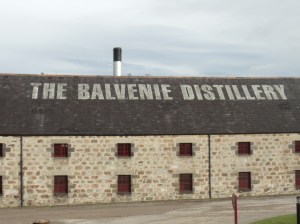
 Having spent a lovely morning touring The Macallan, I made the short trip down the road to my second tour of day at The Balvenie. Now for a quick note; before the introduction of trademarks and copyrights, anyone could use a name to sell and market a product. That’s why a good number of distilleries use the word “The” infront of their names, to seperate themselves from the other illict distillers that were trying to pass off their whisky under someone else’s name. I arrived at the distillery and made my way towards what looked like an old cottage. I peered into the window, and a figure stood up, waved, and made his way to the door. With a firm handshake and a slight smile the gentleman introduced himself, welcomed me into the house and lead me into a fancy sitting room. Inside the room there were a couple of soft leather sofas, a fireplace and tray with tea, coffee, and the nicest Scottish shortbread cookies I’ve had in some time. As I took a seat, David introduced himself, as he has the enviable position of being the distillery ambassador. With all the formal introductions out of the way, we were ready to begin the tour, but first we sat down for a quick chat.
David began by telling me that I was the only person booked for this afternoon’s tour, and then began with some questions to gauge what sort of background I had with whisky and distillery tours. I told David which distilleries I had visited, some of my favourite whiskies, and some of the experiences I’ve had on other tours. There was a small pause, then David burst into life, and he told me that he wouldn’t bore me with the whisky making process, as I had seen it often enough to understand the basic principals, but rather show me the little things that make The Balvenie so special. I now had a sense that this tour was going to be something to remember, and I sure wasn’t disappointed.
 We began by visiting the malting floors. Only a small number of the malt whisky distilleries in Scotland continue to use a malting floor, as the process is very time consuming and very labour intensive. Now most of the barley is malted by a handful of companies in large machines that are quite similar to clothes dryers and transported to the distillery. Even those distilleries that have malting floors (like The Balvenie and Highland Park), can only malt upwards of twenty percent of their barley and rely on purchasing the rest from the malting companies. On the floors, wet barley is spread out and dried to allow for germination which will then allow for fermentation later in the distilling process. In order to make sure that all the barley dries evenly, it needs to be turned. This is done with large wooden paddles, sometimes as many as four times a day. Having looked at the malting floors I told David that on my trip to Highland Park, I had my picture taken turning the barley. Well, no sooner had I said that, and David handed me a paddle, known as a shiel, and snapped a couple of pictures. I’m sure the maltmen weren’t impressed with the mess I left, but it’s certainly an experience I’ll cherish for many years to come. From the malting floors we made our way to the kiln, where they dry the malted barely before milling. On the main floor sits an fire, much like a fireplace in someone’s home, and directly above is a grated floor on which the barely lays. Beside the fireplace is a chalkboard indicating when this batch began, and at what time fuel needs to be added to the fire. The Balvenie like a number of distilleries uses peat to flavour their barley, but unlike the Islay distilleries they only use a very small amout, for a very short time. David looked at me, and within seconds I was placing some peat on the fire. It was now time to move on, and we made our way over to the wash and still houses.
We made our way through the wash house, complete with traditional wooden washbacks, and arrived at the still house. The copper stills used in the distillation process have just as much of an impact on the flavour of the spirit as the ingredients and the casks in which they mature. Any alteration to the shape or a size of a still will alter the spirit inside, so The Balvenie relies on a coppersmith to repair and maintain their stills. Unlike many distilleries who contract out such work, The Balvenie has their own coppersmith on site everyday to make sure that the stills are in prime condition. After the spirit has passed through both the wash and spirit stills, it needs to be aged, and for that we need oak casks. It was time for the next portion of my tour, and we made our way out to the cooperage and Warehouse 24.
The cooperage is where all the casks are stored and prepared for use. Once again, this is a practice that most distilleries source to outside agencies, but The Balvenie feel that it’s crucial to the final product, and place their trust in seven coopers who work all day repairing and rebuilding casks. It was quite a sight to see how the coopers fixed up old damaged casks with tools that haven’t seemed to have changed in the last hundred years. When each cask was finished, the ends were painted black and they were stacked onto pallets to be sent off to the filling station. Seeing all this attention to detail, I began to understand how passionate the workers are of their spirit, and what it means to them to produce a whisky of exceptional quality.
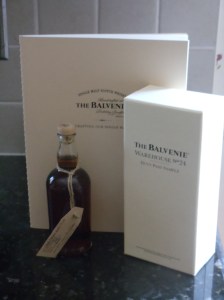 The second last stop on the tour was Warehouse 24. Although Warehouse 24 is an old stone warehouse from many years ago, most of the aging process takes place in larger, modern warehouses. A couple of winters ago, the snowfall was so heavy that throughout Scotland several warehouse roofs collapsed under the extreme weight. At The Balvenie, it was decided that easiest way to repair the roof was to build a new building around the existing one, and to leave the original warehouse untouched inside. Thankfully Warehouse 24 was uneffected, as it was another highlight of my tour. Inside the door lay three barrels: a sherry cask, a port cask and bourbon cask. David walked over to the first cask and dropped a copper pipe on a chain through a hole in the top and waved me over. He asked if I would like a sample, but if I did, I would have to drink it out my hands. I couldn’t say yes quick enough and before I knew it, I was lapping up the whisky from the palms of my hands. We repeated the same process for the two remaining casks and I was asked to choose a favourite. It was a touch choice, but in the end I chose the first cask, the sherry butt. What came next was simply amazing. David gave me the opportunity to fill my own bottle directly from the cask. He gave me a little glass bottle, 200mL I believe, and passed me his copper pipe. I dipped it through the hole in the top of the cask and listened to sound it made as it filled with the spirit inside. When it was full, I gently pulled up on the chain and with a steady hand, poured the whisky in the bottle. I placed a cork in the top and held it up to admire my accomplishment. David filled out a tag and placed it around the neck of the bottle, detailing from which cask the whisky came, the date, and the alcoholic strength (59.5%). Finally I placed the bottle in a box, and had officially done one of the coolest things ever. With my bottle in hand, we left the warehouse and made our way to our final stop, the tasting room.
Inside the little cottage we sat down at a beautiful oak table and David began pouring some drams. We began the tasting with a personal favourite of mine, the 12 Year Old Doublewood, and moved along to the 12 Year Old Signature. Up next was the Balvenie 15 Year Old Single Barrel, followed by the 21 Year Old Portwood. I was in heaven, each of the whiskies were so smooth, and so mellow, it was beginning to become apparent that all the small things The Balvenie does in order to maintain their exceptional level of quality were paying dividends. Finally, it was time for the fifth, and final whisky of the afternoon, The Balvenie 30 Year Old. Bottled at a slightly higher strength than most whiskies, it warmed on the way down and left a gentle tingle on the gums, it was sheer delight. With that my tour was over, and I no matter how many times I thanked David, it wasn’t enough, for I had just taken the best tour ever. I’ve had the chance to take some tours elsewhere, Highland Park will always be special to me as it was my first tour (it’s also my favourite whisky), and Glengoyne’s Masterclass was unbelievable, but having spent the afternoon with David at The Balvenie, I can honestly say that was an experience I shall hold dear to myself for the rest of my life. Now it was time to head back to The Mash Tun for a well deserved meal, and a quiet night’s rest.




 Fun Bob's Booze Blog